Economists with Guns: Authoritarian Development and U.S.-Indonesian Relations, 1960-1968 by Bradley Simpson
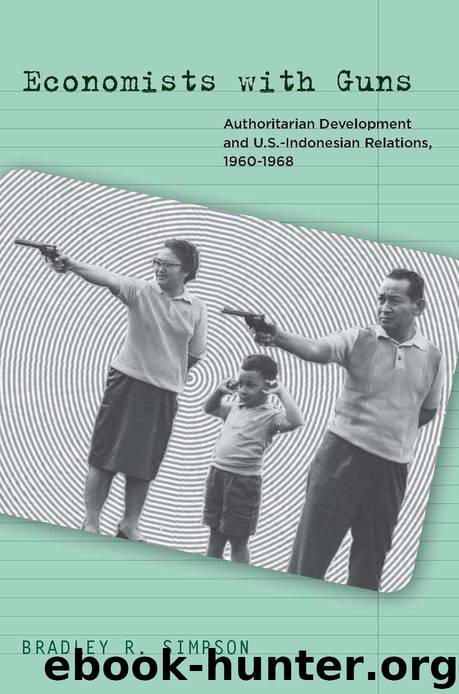
Author:Bradley Simpson [Simpson, Bradley]
Language: eng
Format: epub
ISBN: 9780804779524
Publisher: Stanford University Press
Published: 2008-03-27T21:00:00+00:00
The Post–September 30 Massacres and the U.S. Response
U.S. officials initially thought that the struggle against Sukarno and the PKI would be bitter and protracted. But evidence reaching the embassy in Jakarta by the end of October indicated that the army was moving decisively to break the back of the PKI and defying or ignoring President Sukarno’s efforts to restrain it. Local military commanders were taking the initiative to ban the PKI and its affiliates, whereas weak PKI branches simply dissolved in a desperate attempt to stave off annihilation. Only a month after the murder of the generals, the PKI had been banned or dissolved in almost all of Java and Sulawesi, and despite his maneuvering, cajoling, and threats, Sukarno was proving unable to shield his political allies from attack.61 The army was especially keen to get Subandrio (whom the political correspondent of the army newspaper Berita Yudha described to Australian embassy officials in Jakarta as “a bastard who will get what’s coming to him”), in part because it could not challenge Sukarno directly. In late October army leaders convinced the president to remove Subandrio from his position as foreign minister, later placing him under house arrest when he attempted to leave the country.62
As the welcome returns on the army’s campaign against the PKI poured in, Marshall Green’s anxiety dissipated and he prodded Foggy Bottom to “explore [the] possibility of short-term one shot aid on covert, non-attributable basis” as a sign of U.S. support.63 The State Department replied with a lengthy assessment approved by Dean Rusk. The PKI was “in headlong retreat in [the] face [of] mass attacks encouraged by Army,” which was “already making top policy decisions independently of Sukarno and is more and more acting as a de facto government.” Moreover, as Indonesia’s economic and political crisis deepened, the military would have to turn to the West for assistance, with the United States and Japan in particular poised to help. The army would need food, raw materials, access to credit, and “small weapons and equipment . . . to deal with the PKI.” As a result, “the next few days, weeks, and months may offer unprecedented opportunities for us to begin to influence people and events, as the military begin to understand problems and dilemmas in which they find themselves.”64 This meant, in the short run, signaling to army leaders the need to halt Konfrontasi, cease political attacks against U.S. policy, and end the harassment of U.S. oil companies.65
At the end of October, White House officials established an interagency working group to plan for covert aid to the Indonesian military to meet its needs in fighting the PKI. Many initial reports reaching the embassy couched PKI resistance to Muslim and army-led attacks as the opening salvos of a possible guerrilla campaign.66 Although in most regions the PKI—which had never organized itself for armed struggle—was unprepared for the attacks against it, the party was putting up stiff resistance in Central Java. A few days before the working group met, the
Download
This site does not store any files on its server. We only index and link to content provided by other sites. Please contact the content providers to delete copyright contents if any and email us, we'll remove relevant links or contents immediately.
| Arms Control | Diplomacy |
| Security | Trades & Tariffs |
| Treaties | African |
| Asian | Australian & Oceanian |
| Canadian | Caribbean & Latin American |
| European | Middle Eastern |
| Russian & Former Soviet Union |
The Secret History by Donna Tartt(19311)
The Social Justice Warrior Handbook by Lisa De Pasquale(12225)
Thirteen Reasons Why by Jay Asher(9002)
This Is How You Lose Her by Junot Diaz(6962)
Weapons of Math Destruction by Cathy O'Neil(6371)
Zero to One by Peter Thiel(5874)
Beartown by Fredrik Backman(5846)
The Myth of the Strong Leader by Archie Brown(5552)
The Fire Next Time by James Baldwin(5508)
How Democracies Die by Steven Levitsky & Daniel Ziblatt(5276)
Promise Me, Dad by Joe Biden(5192)
Stone's Rules by Roger Stone(5133)
A Higher Loyalty: Truth, Lies, and Leadership by James Comey(5020)
100 Deadly Skills by Clint Emerson(4975)
Rise and Kill First by Ronen Bergman(4840)
Secrecy World by Jake Bernstein(4804)
The David Icke Guide to the Global Conspiracy (and how to end it) by David Icke(4775)
The Doomsday Machine by Daniel Ellsberg(4557)
The Farm by Tom Rob Smith(4553)
